
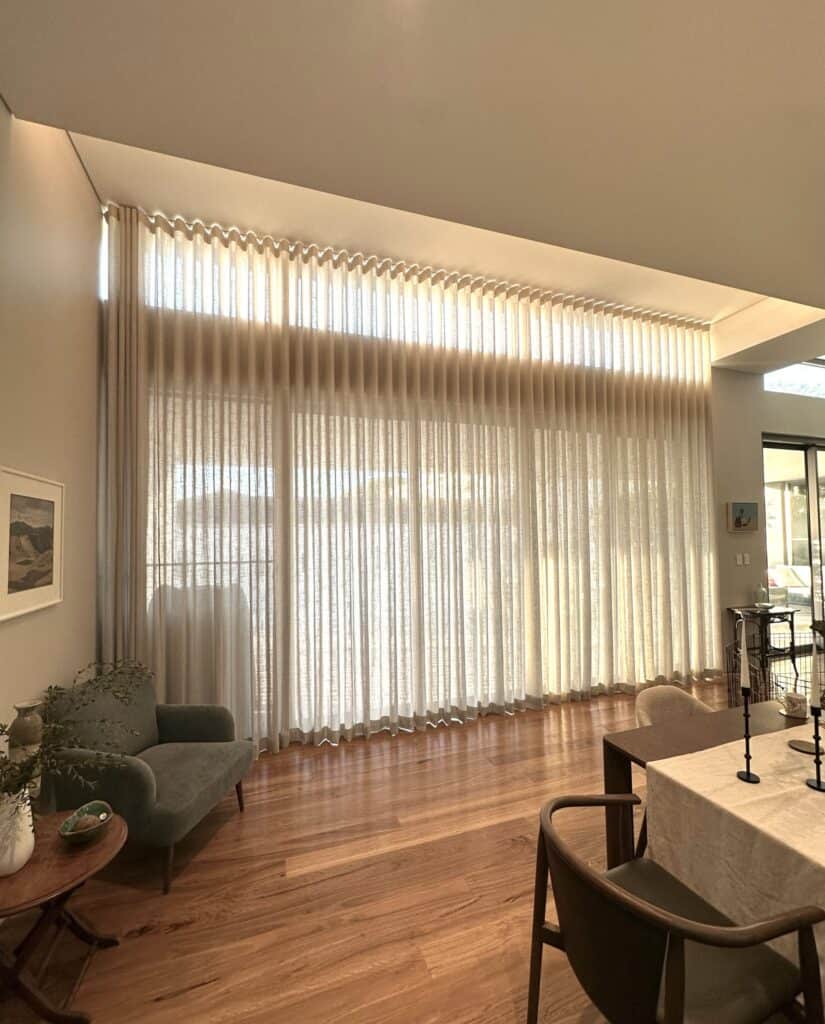
A tall ceiling can make a villa feel open and impressive, but large vertical spaces can also leave windows looking oddly disconnected from the room. Curtains play a bigger role here than simply covering glass. Their height, folds, fabric weight, and track position can influence how the entire space feels. Wave curtains offer a clean approach because their continuous folds create vertical movement without making a tall room appear overly decorated.
Let Curtains Follow the Architecture
When a villa has double-height windows or unusually tall glass doors, short or poorly positioned curtains can make the architecture feel divided. Extending the treatment closer to the ceiling creates a stronger visual relationship between the window and the room above it.
- Mount the track close to the ceiling when the architecture allows it.
- Extend the fabric toward the floor for an uninterrupted vertical line.
- Consider the full height of the opening rather than measuring only the glass.
- Keep the curtain arrangement aligned with nearby architectural features.
This approach makes the window treatment feel like part of the original design rather than something added after the room was finished.
Choose Folds That Suit Tall Spaces
Wave curtains create evenly spaced curves across the fabric. That consistency becomes particularly useful in large rooms because the folds establish rhythm without introducing complicated patterns.
- Use a consistent wave depth across the entire curtain.
- Avoid excessive fullness that can make large fabric panels look bulky.
- Select a track system designed to maintain regular spacing.
- Check how the folds look when the curtains are fully closed and stacked open.
The right fold pattern should complement the scale of the room. A controlled wave can soften a huge glass wall while keeping the overall appearance refined.
Select Fabric With the Room’s Scale in Mind
Fabric choice becomes more noticeable when curtains cover several metres of height. A material that looks lightweight on a small window may behave very differently across a double-height opening.
- Sheer fabrics can soften strong sunlight while preserving brightness.
- Blackout fabrics work well in bedrooms and spaces requiring stronger privacy.
- Textured materials can add depth without relying on bold prints.
- Linen-look fabrics suit relaxed villa interiors with natural finishes.
- Heavier decorative fabrics can create a richer appearance but need suitable support.
For homes searching for tailored window treatments, wave curtains dubai options can be selected according to the room’s daylight, privacy requirements, furniture, and architectural character.
Think About Track Position and Operation
A beautiful curtain can lose its impact if the track sits awkwardly or becomes difficult to operate. Tall villa windows often make manual handling inconvenient, particularly when the curtains are wide and heavy.
- Ceiling-mounted tracks create a cleaner transition from ceiling to fabric.
- Wall-mounted systems can work when ceiling installation isn’t practical.
- Motorized tracks make large curtains easier to open and close.
- Remote, app, wall-switch, or smart-home controls can simplify daily use.
- Scheduling can help manage sunlight and privacy throughout the day.
Motorized curtains become especially practical when windows are positioned several metres above the floor or span a large living area.
Balance Privacy, Light, and Visual Depth
Large villa windows often serve multiple purposes. They bring daylight inside, connect the interior with outdoor views, and can also expose the room to neighbouring properties. A single fabric may not handle every requirement comfortably.
- Pair sheer curtains with blackout layers where flexibility is needed.
- Use light-filtering fabric in bright living areas where complete darkness isn’t necessary.
- Consider the direction of sunlight before selecting fabric density.
- Keep layered tracks visually neat so the window doesn’t become crowded.
Layering also gives tall rooms more depth. During the day, a sheer layer can soften the view, while a heavier layer provides privacy when required.
Avoid Common Mistakes With Tall Windows
Large windows amplify design mistakes. A curtain that feels slightly wrong on a standard window can look noticeably unbalanced when repeated across a double-height opening.
- Don’t stop curtains significantly above the floor without a design reason.
- Avoid tracks that sit far below the ceiling when the goal is to emphasise height.
- Don’t choose fabric solely by appearance on a small sample.
- Check how the material hangs at full length before finalising it.
- Avoid mixing inconsistent wave spacing across adjoining panels.
Proportion matters more than decoration. The curtain should support the architecture rather than compete with it.
Conclusion
High ceilings don’t need dramatic decoration to feel complete. The right curtain treatment can quietly connect the ceiling, windows, walls, furniture, and natural light into one composition. Wave curtains bring controlled folds, clean vertical lines, and practical flexibility to tall villa interiors. When track placement, fabric, fullness, and operation are planned together, the height of the room becomes a deliberate design feature rather than an awkward space that needs filling.