
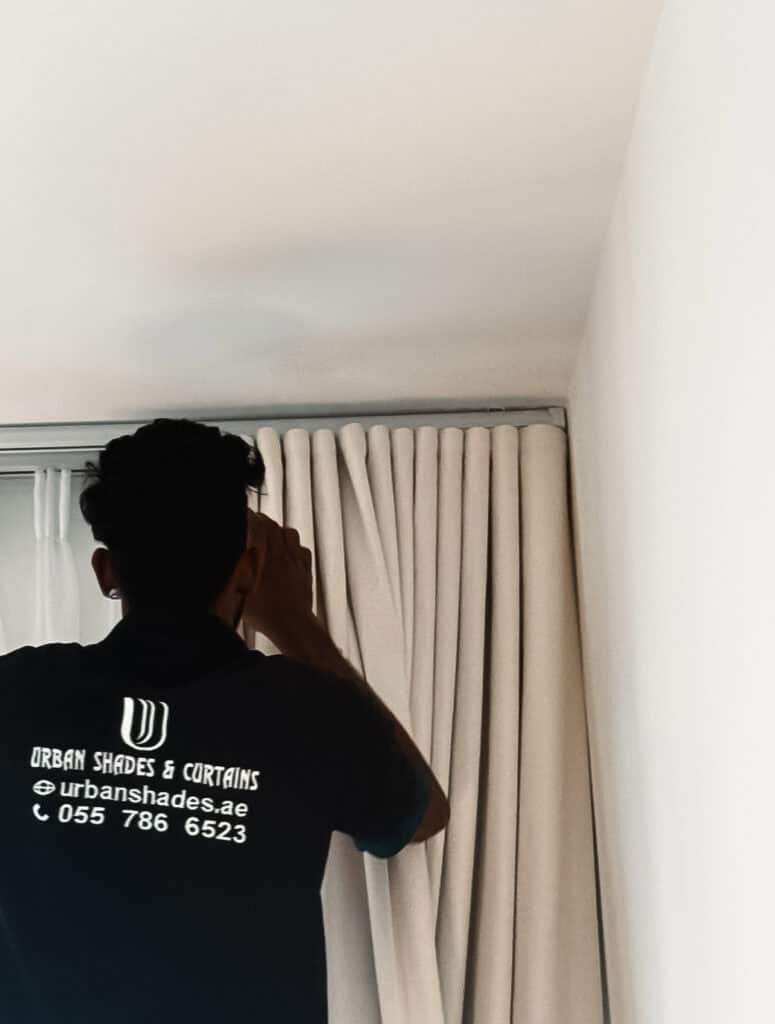
The right fabric quantity determines whether wave curtains form neat, continuous folds or look stretched and uneven. The calculation isn’t based on window width alone. Track length, fullness, finished drop, fabric width, and pattern repeat all affect the final order.
Start With the Track Width
Begin with the curtain track, because the fabric must cover the track rather than simply the glass area. Measure from one end of the track to the other.
- Record the full track width in centimetres.
- Include any track extension beyond the window frame.
- Decide whether you need one panel or two.
- Confirm the wave system’s recommended fullness ratio.
Wave systems commonly use around 2 to 2.3 times fullness, but the correct ratio depends on the tape and glider spacing. Check the track specification before choosing a multiplier.
Calculate the Fabric Width
Fullness creates the repeating wave shape. To estimate the basic fabric width, multiply the track width by the specified fullness.
For example, a 300 cm track with 2 times fullness needs about 600 cm of fabric width before construction allowances. At 2.3 times fullness, the same track needs about 690 cm.
- Track width: 300 cm
- Fullness: 2 times
- Basic fabric width: 600 cm
- Extra allowance: side hems, seams, and pattern matching
Measure the Finished Drop
Measure the drop from the point where the wave tape will hang to the intended bottom of the curtain. For ceiling mounted tracks, start at the track. For wall mounted tracks, measure from the actual hanging position.
- Measure the height in more than one place.
- Check for uneven floors or ceilings.
- Decide whether the curtain ends at the sill or floor.
- Add the required heading and bottom hem allowance.
Floor length curtains usually look cleaner with a small clearance above the floor.
Check Fabric Width and Pattern Repeat
Fabric width affects how many drops are needed. Wide-width material may require fewer joins, while narrower fabric can need several vertical drops.
- Check the usable width, not only the roll width.
- Allow for selvedges and cutting waste.
- Check the pattern’s vertical repeat.
- Add material when pattern matching is required.
A large geometric print can increase fabric consumption because adjoining drops need careful alignment.
Fabric Type Changes the Calculation
Fabric weight and drape influence how much fullness looks appropriate. A lightweight sheer and a dense blackout fabric won’t behave identically on the same track.
- Check fabric weight and drape.
- Confirm whether lining needs a separate calculation.
- Consider shrinkage for natural fabrics.
- Check whether the fabric requires pattern matching.
A Practical Dubai Example
Imagine a bedroom with a 360 cm track and a specified 2 times fullness. The basic fabric width is 720 cm. If the finished drop is 270 cm, the cut length must also include the heading and bottom hem allowances.
For plain material, the calculation is relatively simple. Patterned fabric may require additional material for matching. When ordering wave curtains dubai, provide the supplier with the track width, finished drop, fullness requirement, fabric type, and pattern details.
Consider Motorized Curtains
Motorized curtains need the same fabric calculation, with one extra consideration: total curtain weight. More fabric can mean a heavier load on the track and motor, particularly with blackout materials.
- Check the motor and track’s weight capacity.
- Don’t add fullness beyond the system specification.
- Confirm stacking direction and available space.
- Match the fabric calculation to the selected motorized system.
The goal isn’t simply to buy more fabric. It is to achieve the intended wave while keeping the complete system balanced.
Final Measurement Checklist
Before placing the order, verify the complete specification. This simple check can prevent costly alterations and fabric shortages.
- Track width
- Finished drop
- Fullness ratio
- Usable fabric width
- Pattern repeat
- Hem and heading allowances
- Lining requirements
- Number of panels
- Track and motor capacity, if applicable
When these measurements work together, wave curtains produce consistent folds, sit correctly on the track, and give the room a polished finish. A reliable fabric estimate comes from the whole curtain system, not the window size alone.