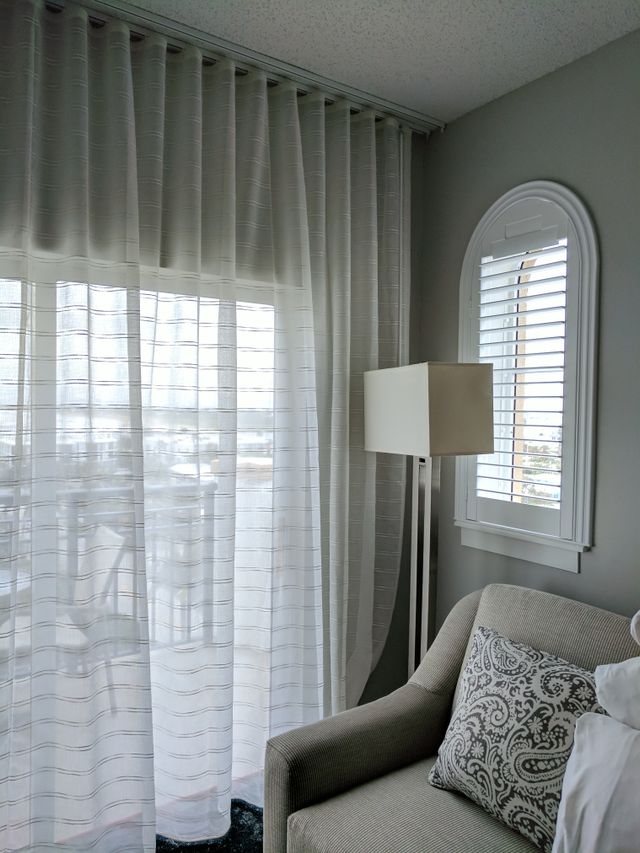
A wave curtain looks simple when it hangs across a window, but the smooth folds depend on a carefully coordinated track system. The fabric doesn’t create those regular curves by itself. Curtain tape, gliders, track channels, and precise spacing work together to produce the continuous pattern associated with wave curtains. Understanding these components helps homeowners choose the right system for large windows, sliding doors, and contemporary interiors.
What Is a Wave Curtain Track?
A wave curtain track is a specialised system designed to maintain consistent folds as the curtain moves. Instead of attaching the fabric to individual hooks in a conventional arrangement, the track uses gliders positioned at controlled intervals.
Each glider connects to the curtain heading tape. As the curtain opens or closes, the gliders move along the track while maintaining their spacing. This creates the repeated S-shaped pattern rather than irregular bunching.
- Uses a dedicated track designed for wave headings.
- Keeps curtain folds evenly distributed.
- Can be fitted to walls or ceilings.
- Supports different curtain fabrics and weights.
- Can accommodate manual or motorized operation.
How Does Wave Curtain Tape Work?
Wave curtain tape is sewn along the top edge of the curtain. It contains specially positioned pockets or attachment points that connect with the track gliders. The tape determines how the fabric behaves as it moves, so its compatibility with the selected track matters.
The relationship between the tape and gliders creates the characteristic wave pattern. If the wrong heading tape is paired with a track, the folds may look uneven or fail to form correctly.
- Connects the curtain fabric to the glider system.
- Helps maintain consistent fold formation.
- Must match the spacing specification of the track.
- Provides attachment points along the curtain heading.
- Influences how the finished curtain stacks and closes.
What Are Wave Curtain Gliders?
Gliders are the small moving components inside the curtain track. Each one connects to the curtain tape and travels through the track channel. Their spacing determines how closely the fabric folds sit together.
Think of the gliders as the framework behind the visible curtain. You don’t normally notice them once the fabric is installed, but their movement controls the curtain’s rhythm from one end to the other.
- Move smoothly inside the track channel.
- Connect directly with the curtain heading.
- Maintain the designed distance between folds.
- Support manual curtain movement.
- Specialised systems can support motorized movement.
Why Does Glider Spacing Matter?
Spacing is one of the most important details in a wave curtain installation. The distance between gliders determines the depth and frequency of the folds. A suitable spacing pattern gives the curtain a consistent appearance across the entire window.
The required spacing depends on the track and tape combination. That’s why mixing components from different systems without checking compatibility can affect the finished result.
- Consistent spacing produces uniform waves.
- Incorrect spacing can distort the fold pattern.
- Wider spacing can create a different visual rhythm.
- The fabric must provide enough fullness for the intended waves.
- Track and tape specifications should be considered together.
How Much Curtain Fabric Does a Wave Track Need?
Wave curtains require more fabric than the finished window width because the material needs enough fullness to form its folds. The exact amount depends on the selected system, spacing, fabric characteristics, and track dimensions.
For homeowners researching wave curtains dubai, this calculation becomes particularly relevant for expansive windows and full-height glass doors. A wide opening can require substantial fabric, making accurate measurement important before production begins.
- Measure the required track width rather than guessing from the glass alone.
- Account for fabric fullness when calculating material.
- Consider where the curtains will stack when fully open.
- Check the manufacturer’s recommended fullness ratio.
- Allow professional installers to verify measurements before fabrication.
Choosing and Installing the Right Wave Track
A good wave curtain system begins with the track, but installation determines how well everything performs. Ceiling-mounted tracks can create a streamlined appearance, while wall-mounted options work where ceiling fixing isn’t suitable. The track must also be level and securely fixed to support smooth movement.
Urban Shades can help homeowners coordinate the track, tape, fabric, and installation rather than selecting each component independently. This approach is especially useful for large Dubai windows where small measurement errors can become obvious across a wide span.
- Choose the mounting method according to the room structure.
- Check the track length and required stacking area.
- Select hardware according to curtain weight.
- Ensure the track is properly aligned during installation.
- Consider motorization for large or frequently operated curtains.
Conclusion
Wave curtain tracks rely on several small components working as one system. The track guides the movement, gliders maintain the spacing, and heading tape connects the fabric to that mechanism. When these elements match correctly, the curtain produces smooth, consistent folds and operates cleanly. Urban Shades can assist with selecting compatible components and planning the installation so the finished treatment suits both the window and the wider interior.